
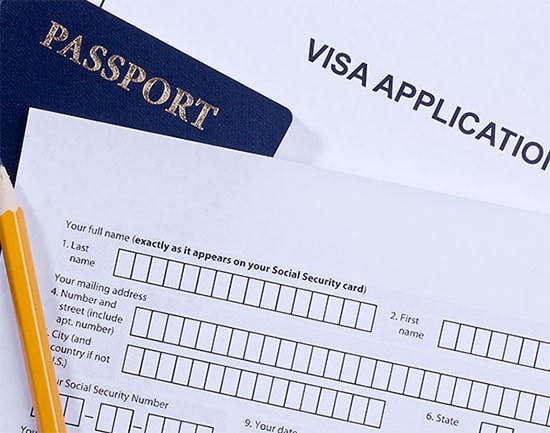
Form I-134 is a document that you, a United States permanent resident or citizen, use to declare that you will financially support an immigrant during their temporary stay in America. The temporary stay can be for medical treatment, to accompany a child to school, for medical attention, a short-term education program, a humanitarian parole application, or tourism. You are called a sponsor, whereas the immigrant is known as a beneficiary. After you have verified that I-134 is the appropriate document, you should follow the right guidelines and steps to ensure you complete it appropriately.
What is I-134?
Immigration benefits that include a stay in America require the United States Citizenship and Immigration Services to determine if the beneficiary or applicant has adequate financial resources to cover their expenses during their temporary stay.
If you are the one signing and bringing the I-134, you should establish that you have sufficient funds and access to money to support your loved one during the beneficiary's stay in America. Your beneficiary is not required to reimburse, repay, or compensate you for bringing an I-134 for them or for offering financial support during their stay in America.
Specific people applying for public benefits should file Form I-121 and bring Form I-134 with Form I-131. I-134 is brought either by the parole applicant themselves or by someone else on the applicant's behalf.
The Risk of Submitting an I-134 for Your Foreign Visitor
Filling out and signing I-134 means assuring the USCIS that the non-immigrant whom you intend to sponsor will not pursue public help, including food stamps, among other government benefits.
If your visitor applies for and receives public help, the government authority may consider your wages and property when determining whether to issue the public benefits. Additionally, USCIS can take legal action against you to recoup the amount of public assistance you are offering your relative.
On the contrary, the temporary declaration of your support on I-134 is called unenforceable. It differs from Form I-864, which is used by citizens and permanent residents when sponsoring immigrants for a permanent residence card. Here are reasons your I-134 is unenforceable:
- A visitor to America does not qualify for most of the government public benefits, and when they apply, the government might deny them
- The American government has limited resources and time to enforce the conditions of I-134, regardless of whether your visitor manages to obtain public assistance
- You, the sponsor, will agree to support your visitor for a specific duration; therefore, any liabilities are restricted to the duration of their temporary stay
Advice for Specific Categories of Beneficiary
If the immigrant is coming to the U.S. as a visitor, as a visa lottery winner, or to marry a United States citizen, here is tailored advice. Following these guidelines will prevent making mistakes and ensure the process is seamless.
A Visitor Visa Applicant
One hurdle an applicant for a visitor visa to America faces is establishing that they do not intend to settle permanently. You can overcome the hurdle by demonstrating that you have sufficient funds to cover your stay without working. If you can prove this, submitting an I-134 is unnecessary.
If you have loved ones in America, they can assist you in preparing the I-134 before sending it to you for submission at the visa interview. While USCIS will not accept I-134 as proof that you will not become a public charge, it could still assist.
A Diversity Visa Applicant
When applying for permanent residence, you should prove that you are inadmissible (ineligible for entry to America due to any record, including criminal or negative health). If the US government believes that you can become a public charge, you are inadmissible.
You can overcome this finding by having a loved one who is a permanent resident or citizen prepare an I-134 for you.
Completing I-134 Part 1
You can find more information about the form and guidelines on the official USCIS website.
Select the initial box if you want to bring 1-134 for yourself and plan to support yourself.
If you are financially supporting a person applying for immigration benefits, check your second box.
Part 2: Details about You, the Person Financially Supporting Your Beneficiary
You should provide details about your employment, bank accounts, and properties, among other financial information.
Questions One to Seven
Complete your name, previous names (including before marriage), birthday, place of your birth, and physical and mailing address. Ensure you print or type the country's name as it was during your birth, even when your country of birth is nonexistent or has changed its name.
Question Eight
If you hold a green card, you should provide the Alien number.
Question Nine
You will have a U.S. Citizenship and Immigration Services account number if you entered the nation as an immigrant and enrolled for the account when pursuing your application.
Question Ten
Here, you state whether you hold a green card, are a United States citizen, or are a nonimmigrant. The I-94 number is on the paperwork you received upon entry into the U.S. or from USCIS when altering your status.
Question 11
You should choose the right box for your immigration status. Submit proof of immigration status. If you are a national or citizen, you provide copies of your birth certificate, a certificate of your citizenship, and a consular report of your birth to United States parents. If you hold a green card, you should provide photocopies of your I-551 or your green card. If you are a lawful nonimmigrant, you should provide copies of your visa in your foreign passport.
Questions Fourteen, Fifteen, and Sixteen
You should give details about people who depend on you. It can include your relative or beneficiary listed on Form I-133, for whom you submitted Form I-84A, agreeing to sponsor an immigrant with your assets and income.
Question Seventeen
Provide details about your wages. If you brought your tax returns, even the figure outlining the gross income. If you have yet to file your tax returns, take the household incomes from every legal source for the last year and enter the figure as the household income.
However, if you have not brought your tax returns but have your Internal Revenue Service Form W-2, covering a one-year duration, take your income, subtract the income taxes you retained, and enter the figure as the household annual income. You cannot depend on income earned from unlawful conduct, including proceeds from unlawful drug sales or gambling, regardless of whether you paid your taxes on the income, to prove you have adequate resources to support your beneficiary.
Question 18
Here, you should provide details about the property you intend to utilize to support your relative for the expected duration of their stay. Highlight only properties that you can convert into money within a year that you will use to support your loved one during their stay in America. Avoid including properties from any person you have highlighted in Part Three.
You can include the value of your home as property. Your home’s net value is its appraised value minus the amount of any loan obtained through a trust deed, mortgage, or any lien on your home. When you add your house's net value, you should include documents proving that you possess the house, a current appraisal conducted by a certified appraiser, and proof of the money or plans pledged by a trust deed, mortgage, or any lien on your home.
You cannot include your car’s net value unless you prove that you own at least one vehicle, and more than one car is excluded as property.
File proof of the worth of your household member’s assets or your property. The evidence should include the property holder's name, property description, ground for the property owner’s title, the net cash worth, and proof of ownership.
Part 3: Details about Your Beneficiary
In this part, you will present personal details about the immigrant who you will financially sponsor. Below are guidelines on how to answer different questions:
- In question 1, provide your beneficiary's name as indicated on their lawful name change documentation or birth certificate. If your loved one has two legal last names, use both and a hyphen between them. Print or type your beneficiary's middle, last, and first names in every appropriate field.
- In part 3, you will provide the immigrant's birthday. Many of these queries are straightforward.
- In question 4, answer whether your loved one was delivered a female or male as issued on their birth certificate, provided during birth, or provided in secondary proof they presented to USCIS or closest to during birth.
- Regarding Question 5, your visitor will have an Alien number if they have previously visited the U.S., have a work visa, or are in removal or deportation proceedings. If your visitor has been in a removal or deportation proceeding, hire a lawyer.
- In question 6, provide the name of that country, town or city, and province or state where your loved one was born. Print or type the country’s name as it was called during your beneficiary's birth, even when that country does not exist, or its name has been changed.
- Regarding question 7, give the country's name where your loved one is a national or citizen. It does not have to be the nation where your loved one was born. If your beneficiary is not a citizen in any given country, print or type "stateless," and give more explanation in Additional Information in Question 8.
- For question 8 on marital status, choose the correct box.
- Regarding Question 12 about the expected duration of stay, it does not surpass six months. The visitor is not allowed to stay beyond that duration. If your loved one’s stay will end at a specific date, you should provide the expected date in the provided space.
Part 4: Statement, Contact Details, Certification, and Signature of Your Beneficiary
Since you are the sponsor, you can skip this part.
Part 5: Your Certification, Contact Details, Signature, and Statement as the Individual Agreeing to Support Your Beneficiary
The section describes your responsibility when you sign the I-134. Please ensure you read it thoroughly to understand. You should date and sign the form.
You should complete the remaining parts if another person, like a lawyer or interpreter, helped you with the form.
General Instructions
I-134 requires careful attention to detail to avoid denial. Here are additional instructions to follow:
Guidelines on Signature
You should complete your declaration. USCIS does not accept a typewritten or stamped name instead of a signature on the declaration. If your child is below fourteen, you, the legal guardian or parent, must sign the declaration for them. A legal guardian might sign for a mentally incompetent individual. If you fail to sign the declaration or if your signature is invalid, the USCIS will reject the declaration.
USCIS considers faxed, scanned, or photocopied copies of original benefit requests with handwritten signatures valid for bringing. The scan, photocopy, or fax should be of the original document or request with the handwritten ink signature.
Your Evidence
When you bring the declaration, ensure you file every supporting document outlined in your supporting evidence and specific instructions and evidence.
Biometric Service Appointment
USCIS might want you to submit biometrics (signature, photograph, or fingerprints) or attend an interview to confirm your identity, gather additional information, and conduct background checks before deciding on your petition or application.
If USCIS believes the biometric service appointment is essential, it will send you a notice with the appointment's location, date, and time. If you are outside America, the agency will require you to call the United States consulate, United States Embassy, or USCIS office in your country to book your appointment.
During your appointment, you will sign an oath that:
- You authorized or provided information in your declaration
- You analyzed and understood the content filed with or contained in the declaration
- The information you provided was true, complete, and accurate when you filed
Documents to Attach alongside I-134 Paperwork
You must attach proof to prove the assets and income you will be depending on. Ensure you submit two (2) copies of every document you present and keep one copy for yourself. Here is evidence you can use to prove that you can support your foreign visitor.
- Proof of current income tax filings—The most effective proof is an Internal Revenue Service transcript, a summary of the tax return. You can find details on how to order tax transcripts on the Internal Revenue Service's official website. However, if you have little time left, you can present a copy of the signed tax returns or send copies of your e-signature authorization. If you are self-employed, USCIS can accept reports from a commercial rating agency (a firm that provides credit reports on different businesses).
- Your employer's letter—It will be on firm letterhead and signed and created by your employer or human resources manager. Be sure it has the latest date, your employment duration, your annual salary, your position, and your date of hire. If you are a full-time employee, be sure your employer states that.
- Letters from various financial institutions proving your accounts—You can request financial institutions, including banks that you outlined, to verify your accounts by issuing a letter on letterhead. Typically, it indicates the date you opened the account, the amount you deposited in the previous year, your current balance, and your average balance. If the average balance is lower than the latest balance, it might look suspicious. Therefore, you can request that the financial institution leave the average balance in your letter. You should submit your current bank statements.
- Bond details —If you indicated your bond amount, create a list of their denominations and serial numbers, including the name of the record owner for each bond.
- Receipts or deeds for your property—You might not require this document as a sponsor during the beneficiary's visit. Nevertheless, if you wish to submit proof of your financial status, you can include copies of deeds and titles for homes and cars and receipts for electronics or appliances.
What Happens After Competing I-134
Avoid mailing the form to any government agency, including USCIS. Send your original form to the person you plan to sponsor to carry to the American consulate when seeking their B-2 visitor visa or to attach to their visa application.
Ensure you send that version with an ink signature; the consulate could reject an emailed or faxed form.
After sending your form, you have to wait for the loved one to enter the U.S. under the Visa Waiver Program or for USCIS to approve your relative's visa.
If you are a citizen and your foreign-born fiancée is coming with minor children, these children do not require a different I-134. Including them on the form you completed is adequate.
Find a Competent Immigration Attorney Near Me
I-134 is the financial support declaration you, the sponsor, submit for a beneficiary or visa applicant. It states that you will provide financial support to the beneficiary during their stay. However, completing the paperwork can be lengthy and complicated.
California Immigration Attorney can carefully handle every required document, supporting documentation, and evidence to ensure the application is strong. We can also submit the paperwork to the right address. Our team can ensure that every legal strategy available to you is explored and that you receive assistance with the complex bureaucracy and paperwork, reducing the risk of denial. Please contact us at 424-789-8809 to schedule your initial consultation to learn how we can help you.