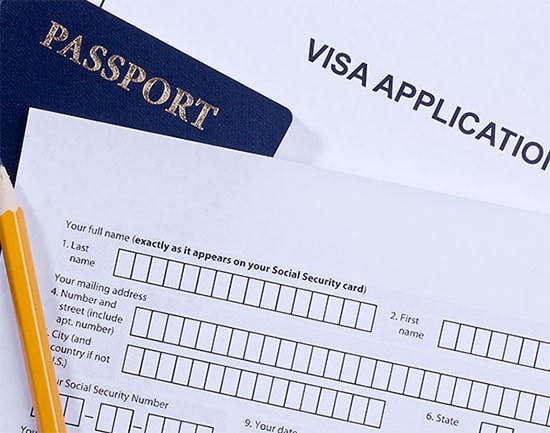
A U.S. consular interview is a legal requirement performed by a consular officer of the U.S. Department of State at a U.S. consulate or embassy in a foreign country to determine whether a foreign national is eligible to receive a U.S. visa. This face-to-face evaluation is conducted under federal immigration laws. It requires the consular officer to establish the identity of the applicant, gather required biometric information, and question the applicant verbally during the appointment to determine their credibility.
This article explains what you will experience on the day of your interview at the embassy. It explains how to move from perimeter security to intake documentation reviews to the final conversation at the bulletproof window. You learn the legal criteria established by the Immigration and Nationality Act (INA), particularly the presumption of immigrant intent under Section 214(b), that consular officers consider when evaluating your oral testimony directly.
Arrival Logistics and Strict Embassy Security Procedures
The first impression you make at the United States embassy sets the tone for your interview. You should be familiar with the exact time requirements and adhere to the strict security protocols provided by federal law. The following sections explain these important steps to help you navigate the exterior checkpoints as efficiently as possible.
Managing Arrival Times and Queue Expectations
Your appointment time is not when your interview begins, but the time you are permitted to join the security line outside the embassy gates. Plan to arrive at the perimeter 15 to 30 minutes before your scheduled window. Do not arrive hours early. Embassy guards will turn you away until your specific time slot is called, leaving you waiting on the sidewalk.
You will be checked at the perimeter checkpoint with your valid passport and printed interview appointment sheet. The security checks your credentials against the list of daily visitors on the master access list at 9 FAM 504.4 before allowing you to join the visitor queue. Busy consular posts process hundreds of applicants each morning.
Have your unexpired passport booklet and appointment confirmation barcode on hand for security staff to confirm your reservation when they call your group to the front.
Navigating Embassy Security Screening and Handling Prohibited Items
The United States embassies have physical screening stations similar to those at federal airports. Security officers conduct physical screening of all visitors and confirm scheduled appointments before granting access to diplomatic facilities, pursuant to the Omnibus Diplomatic Security and Antiterrorism Act (22 U.S.C. § 4802) and Department of State physical security standards in 12 FAM 360.
Place your coat, belt, document folder, and permitted personal items into plastic bins for X-ray scanning before you walk through the metal detector.
Diplomatic security rules are strict, and almost no U.S. embassy provides storage lockers for visitors. If you bring prohibited items to the checkpoint, security guards will turn you away, forcing you to find an outside storage locker or miss your appointment entirely. The Department of State has issued guidelines on what items not to bring to your interview appointment, under the following categories:
- Cell phones, smartwatches, fitness bands, and Bluetooth earbuds
- Portable tablets, e-readers, laptops, and key fobs with electronic buttons
- Backpacks, duffle bags, suitcases, and oversized shoulder purses
- Sealed food products, aerosol sprays, and pocket knives
Security guards will confiscate prohibited items or escort you off the perimeter altogether to ensure that your items are secured in an outside commercial facility. Leave your electronics and nonessential bags at your hotel or with an accompanying companion outside the security perimeter to ensure efficient entry through access control doors into the consular waiting room.
The Check-In and Biometrics Collection Process
Upon passing security, you are taken to the consular waiting room, where formal intake procedures follow. This stage includes verification of documents and compulsory digital fingerprinting. The following sections describe the process that clerks go through with your biometric information before your final visa interview with the consular officer.
Verifying Documentation at the Intake Window
Once in the waiting hall, you enter a bustling, multi-counter setting that resembles a high-volume public agency. The alphanumeric ticket is issued by an intake clerk or an automated ticketing kiosk, depending on your visa classification. Wait in the waiting gallery and watch the digital overhead displays for your alphanumeric sequence to show up.
If your number is called out on the display board, go to the appropriate intake counter. Your initial file will be processed by a Foreign Service National (FSN), a local employee who reviews application packets under the supervision of consular officers pursuant to FAM 504.4-2. The clerk checks your passport and finds that your DS-160 or DS-260 confirmation barcode is readable under the standards outlined in 22 C.F.R. 41.103 or 42.63.
Next, the clerk checks your physical photographs to ensure that they comply with the Department of State biometric requirements 22 C.F.R. § 41.105(a)(3) (for nonimmigrants) or 22 C.F.R. § 42.65(f) (for immigrants). If you are applying for an immigrant visa, the intake specialist will receive your certified civil papers, such as marriage certificates, police clearances, and statutory financial affidavits under INA § 213A, 8 U.S.C. § 1183a. The specialist arranges these forms into an official dossier, enters administrative intake codes into the system, and leads you to the fingerprint collection station next door.
Capturing Digital Fingerprints for Biometrics Verification
Under federal law, consular staff must collect your fingerprints before an officer can review your case. Pursuant to section 221(b) of the INA 8 U.S.C. § 1201(b), implemented through 22 C.F.R. § 41.105(b) (for nonimmigrants) and 22 C.F.R. § 42.67 (for immigrants), staff capture your fingerprints using inkless optical scanner plates mounted directly on the counter ledge. This collection stores your biometric data in the Automated Biometric Identification System (IDENT/HART) of the Department of Homeland Security.
The technician instructs you to put your four left fingers on the illuminated glass plate until the terminal says “capture clear.” Then repeat the procedure with your four right fingers, and press both thumbs together in the middle of the glass. Keep hands clean, dry, and free from superficial cuts, as moist hands, peeling skin, and dirt can cause read errors in the scanner, which can slow your intake sequence.
In compliance with the requirements of the Enhanced Border Security and Visa Entry Reform Act, 8 U.S.C. § 1732, the scanner matches your fingerprint measurements as you scan them in real time with those found in the federal criminal and immigration databases. Your substantive interview is scheduled to take place in the central seating gallery after you are done with your biometric registration at the intake.
Engaging in the Adjudicative Consular Interview
The conversation at the counter window is critical to your appointment. You must answer questions truthfully while actively overcoming the presumption of immigrant intent. The sections below guide you on articulating your answers clearly, presenting documentation efficiently, and maintaining credibility before the adjudicating consular officer.
The Physical Setup and Swearing the Oath
Consular interviews are conducted at a counter window. An integrated electronic microphone-and-speaker system in the window divider allows you to talk with the commissioned American consular officer. Speak clearly and loudly into the intercom grill, with a focus on the noise level on the waiting floor.
The officer will begin by placing you under oath. Through the window intercom, the officer will instruct you to raise your right hand and swear or affirm that everything in your application and all of your verbal answers are true and complete. Willful misrepresentation is defined under the INA § 212(a)(6)(C)(i) of the INA (8 U.S.C. § 1182(a)(6)(C)(i)) as the intentional falsehood or misrepresentation made to a consular official. This statutory violation establishes a permanent ground of inadmissibility for admission to this country for nonimmigrants and INA § 212(d)(3) for qualifying immigrant relatives, unless a discretionary waiver of inadmissibility is granted.
The officer examines your electronic file on two monitors as they administer this oath. With busy dockets, consular officers are often busy typing observations or reviewing cross-agency records while you are talking. Don't get distracted by this ongoing computer review. The adjudicator is already comparing what you say to the electronic forms you've sent.
Answering the Consular Officer's Questions under INA 214(b)
The length of most nonimmigrant visa interviews is 2-5 minutes. Under Section 214(b) of the INA 8 U.S.C. § 1184(b), federal law establishes a strong presumption of immigrant intent for most temporary visitor classifications, including B-1/B-2 tourist visas and F-1 student visas. The officer will presume that you intend to leave your foreign country and to settle permanently in the United States.
Under INA § 291, 8 U.S.C. § 1361, the legal burden rests entirely on you to prove that you plan to return home. However, if you are applying for an H-1B specialty occupation visa (INA § 101(a)(15)(H)(i)(b)) or an L-1 intracompany transferee visa (INA § 101(a)(15)(L)), federal law recognizes 'dual intent.' You do not have to prove ties to your home country for these specific categories.
The adjudicators will ask questions about your travel plans, job position, and financial stability to verify that you are not going to accept jobs that are not authorized under 8 C.F.R. § 214.1(e) and 9 FAM 402.2-5(E). You will need to build strong economic, family, and social connections in your country of residence, which requires you to return there. Apply these operational skills to the management of rapid questioning:
- Give straight answers and be factual, but do not volunteer long stories unless the officer asks you to elaborate
- Avoid shoving papers under the glass unless asked by the officer
- Communicate travel dates, destinations, and hotel accommodations clearly and confidently.
- State your job title, employer, and monthly income clearly, as you did when you filed.
Be honest if the officer asks about relatives in the U.S. Consular posts can view the Consular Consolidated Database (CCD) that provides information on family petitions, naturalization applications, and previous border crossings. Giving an evasive answer is just as damaging to your credibility as lacking required documentation. Maintain eye contact, speak in a calm manner, and present the facts succinctly to enable the consular officer to conduct the interview.
Handling Language Barriers and Interpreters
Consular posts interview in English and the main language of the country in which they are located, as directed by the Department of State's operational guidelines in 9 FAM 504.1-1. When applying for a temporary visitor visa (B-1/B-2) or a family-based immigrant classification, you can speak in your native language or communicate via professional embassy staff interpreters at the window. Consular officers are often fluent in the host country's main language and will switch between languages to evaluate your answers.
Some visa categories require evidence of English-speaking skills as a requirement for the underlying visa. For an F-1 academic student visa, if you are applying for a course of study taught in English, the officer assesses your oral comprehension and speaking skills pursuant to 22 C.F.R. § 41.61(b)(1)(iii) and 9 FAM 402.5-5(E).
Unless your Form I-20 explicitly indicates that you are enrolled in an English language training program or that English proficiency is not required for your initial course of study, the consular officer must verify your spoken English proficiency. If you are enrolled in an English-medium degree program and struggle to comprehend basic questions, the officer may refuse your visa under 22 C.F.R. § 41.61(b)(1)(iii) and 9 FAM 402.5-5(E).
If the electronic speaker system is not loud enough or if you don't hear a certain word, politely ask the officer to repeat the question. Never guess an adjudicator's meaning, as an inaccurate response may create unintended inconsistencies in your official record.
Receiving the Consular Officer's Final Decision
After the interview, the officer makes a determination on the evidence presented immediately. This final decision will determine what you do next on your trip. Today, you can expect three possible scenarios that can be experienced under United States immigration law: visa approvals, administrative processing delays, and visa denials.
Visa Approval and Passport Retention Protocols
If you meet all the statutory requirements, the consular officer will grant your visa orally at the end of the interview based on INA § 221(a), 8 U.S.C. § 1201(a). The adjudicator keeps the physical passport booklet and puts it into an administrative intake bin to get the machine-readable visa foil. Then the officer gives you a printout of an informational flyer with instructions on how to return your passport.
Embassies don't stamp or stick visa foils on passports while you're waiting at the window. Your visa foil will be laminated into your booklet at a dedicated technical unit, which will conduct the final cross-agency security checks and print your visa foil on a blank page of your booklet as per the regulations at 22 C.F.R. § 41.113 for nonimmigrants and 22 C.F.R. § 42.73 for immigrant beneficiaries.
The finalized passport is sent to an authorized commercial courier or delivered to a document distribution facility that is not on-site. Under standard operating conditions, passport processing and courier delivery typically take 3 to 5 business days following visa approval. However, delivery in immigrant visa cases or during seasonal peak periods may take up to two weeks.
Administrative Processing under Section 221(g)
In certain cases, an adjudicator cannot grant the visa immediately because additional information or clearance is required. In these circumstances, federal law mandates that the officer issue a formal statutory refusal under Section 221(g) of the INA, 8 U.S.C. § 1201(g), and 22 C.F.R. § 41.121 (for nonimmigrants) or 22 C.F.R. § 42.81 (for immigrants), commonly referred to as 'administrative processing.' While this refusal pauses application processing until supplemental requirements are satisfied, it is formally recorded as a visa denial under federal law.
The officer provides you with a written Section 221(g) refusal notice, usually on colored paper (blue, yellow, or pink). This document specifies exactly why the administrative delay occurred. If there are no supporting documents, the form specifies the documents that are required:
- A recent federal tax transcript and income documentation from your petitioner
- Police Clearance Certificates from any jurisdiction where you have lived before
- Detailed letters from employers confirming specialized technical job duties
- A revised CV and publication list, and a research objective statement
If your technical background, specialized field of study, or nationality triggers a Security Advisory Opinion (SAO) under 9 FAM 304.2, the post must submit your file to Washington, D.C., for interagency clearance. If the administrative background review is going to take several weeks, the officer will return your physical passport at the counter and tell you to send it back to the consular section when the background review has been completed.
Immediate Visa Denials under Section 214(b)
At the end of the interview, if the officer finds you did not establish nonimmigrant intent or did not demonstrate eligibility for the visa classification requested, they will deny the visa application. The adjudicator issues a written refusal letter stating INA § 214(b) and 8 U.S.C. § 1184(b) and returns your physical passport booklet, thus complying with the statutory notice requirement under INA § 212(b) and 8 U.S.C. § 1182(b). This formal handoff is the end of your appointment, and you will be escorted by security towards the facility exit.
In the case of Consular Non-Reviewability, which was reaffirmed by the U.S. Supreme Court in Department of State v. Muñoz, 144 S. Ct. 1812 (2024), and Kleindienst v. Mandel, 408 U.S. 753 (1972), the federal courts refused to review or overturn a refusal of a visa issued overseas. You cannot dispute with the officer at the window, request to speak to a supervisor at the embassy, or apply for injunctive relief from federal immigration judges.
You may submit a new visa application later on. However, if you reapply without a material or substantial change in your employment, residence, or finances, the consular post will likely issue another refusal under Section 214(b). An examination of the specific reasons for the negative decision will enable you to develop a strong evidentiary plan prior to scheduling a follow-up consular interview.
Call a California Immigration Attorney Near Me
Your U.S. consular interview is a time to be extremely careful to follow the Department of State procedures. Before your interview, you should understand the legal requirements for the visa category you are applying for. Every moment in the embassy is critical, from passing through the tough security checkpoints to answering a consular officer's question under section 214(b) of the INA. This short conversation is what can make or break your visa application.
United States immigration laws are strictly enforced, making timely legal preparation essential. At California Immigration Attorney, we offer free consultations, have experience in all aspects of U.S. immigration law and consular representation, and are prepared to advocate for you. Our legal team works diligently to ensure that your legal rights are protected and that your petition is supported by thorough, compliant documentation. Schedule a consular interview preparation consultation with an experienced immigration lawyer today at 424-789-8809.